






Typed WebSocket APIs for Python. Write one handler per message; chanx routes, validates, broadcasts and documents it, and generates typed clients from the result. Runs on Django Channels, FastAPI, or any ASGI framework.
Documentation · Django quick start · FastAPI quick start · TypeScript clients · Ready-made kits
Why chanx
A raw WebSocket endpoint is one receive method that grows forever:
async def receive(self, text_data):
    data = json.loads(text_data)
    if data.get("action") == "chat":
        if "text" not in data.get("payload", {}):
            return await self.send(json.dumps({"error": "missing text"}))
        ...  # find the room, loop over connections, send to each
    elif data.get("action") == "ping":
        ...
    # no types, no docs, and the frontend guesses the message shapes
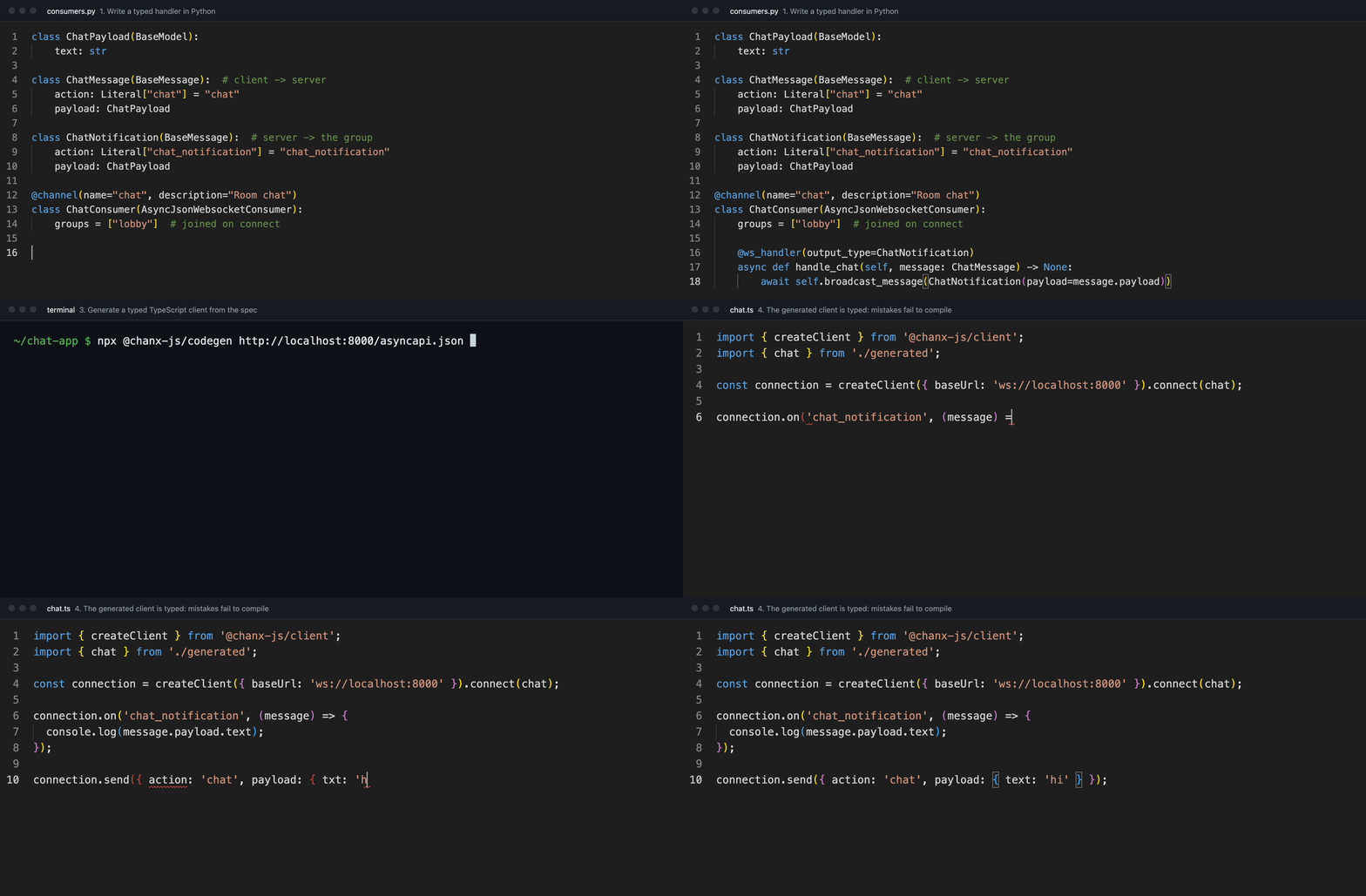
With chanx, each message is a Pydantic model and each handler is a typed method:
@ws_handler(output_type=ChatNotification)
async def handle_chat(self, message: ChatMessage) -> None:
    await self.broadcast_message(ChatNotification(payload=message.payload))
From that, chanx gives you:
- Routing by type. Incoming JSON is dispatched on its
actionfield to the handler whose argument type matches. Noif/elifchains. - Validation. Payloads are checked by Pydantic before your code runs; bad ones get a structured error reply.
- Groups and events. Broadcast to groups, and push messages from HTTP views, tasks or workers through the channel layer (Redis or in-memory).
- AsyncAPI 3.0 docs. A spec and an interactive docs page, generated from your handlers, so the contract the frontend reads is the code that runs.
- Typed clients. Generate a Python client, a TypeScript client with React, Vue, Svelte and Solid bindings via chanx-js, or a Go client via chanx-go.
- Testing and auth. Test communicators for both frameworks, and authenticators that reuse your DRF permission classes on Django.
- Static typing throughout. Checked with mypy and pyright in strict mode, so handler and message mistakes show up in your editor.
Install
pip install "chanx[channels]"        # Django Channels
pip install "chanx[fast_channels]"   # FastAPI, Starlette and other ASGI frameworks
Python 3.11 to 3.13. Optional extras: chanx[cli] for the client generator,
chanx[client] to run generated Python clients.
Quick start
A room chat on FastAPI in one file. Save it as main.py:
from typing import Literal

from fastapi import FastAPI, Request
from fast_channels.layers import InMemoryChannelLayer, register_channel_layer
from pydantic import BaseModel

from chanx.core.decorators import channel, ws_handler
from chanx.fast_channels import asyncapi_docs, asyncapi_spec_json
from chanx.fast_channels.websocket import AsyncJsonWebsocketConsumer
from chanx.messages.base import BaseMessage


class ChatPayload(BaseModel):
    text: str


class ChatMessage(BaseMessage):  # client -> server
    action: Literal["chat"] = "chat"
    payload: ChatPayload


class ChatNotification(BaseMessage):  # server -> everyone in the group
    action: Literal["chat_notification"] = "chat_notification"
    payload: ChatPayload


@channel(name="chat", description="Room chat")
class ChatConsumer(AsyncJsonWebsocketConsumer):
    channel_layer_alias = "default"
    groups = ["lobby"]  # joined on connect

    @ws_handler(output_type=ChatNotification)
    async def handle_chat(self, message: ChatMessage) -> None:
        await self.broadcast_message(ChatNotification(payload=message.payload))


register_channel_layer("default", InMemoryChannelLayer())  # use Redis in production

app = FastAPI()
app.router.add_websocket_route("/ws/chat", ChatConsumer.as_asgi())


@app.get("/asyncapi")
async def docs(request: Request):
    return await asyncapi_docs(request=request, app=app)


@app.get("/asyncapi.json")
async def spec(request: Request):
    return await asyncapi_spec_json(request=request, app=app)
Run it with uvicorn main:app, open two connections to ws://localhost:8000/ws/chat,
and send from one:
{"action": "chat", "payload": {"text": "hi"}}
Both receive:
{"action": "chat_notification", "payload": {"text": "hi"}}
A malformed message ({"action": "chat", "payload": {"txt": "hi"}}) never reaches the
handler; the sender gets a validation error instead. The interactive docs are at
http://localhost:8000/asyncapi.
On Django, the consumer is the same class imported from
chanx.channels.websocket, routed with Channels, with docs from
path("asyncapi/", include("chanx.channels.urls")). See the
Django quick start.
Typed clients
Clients are generated from the AsyncAPI spec, so they always match the server.
TypeScript, with chanx-js:
npm install @chanx-js/client
npx @chanx-js/codegen http://localhost:8000/asyncapi.json -o src/generated
import { useChannel } from '@chanx-js/client/react';
import { chat } from './generated';

function Chat() {
  const { send } = useChannel(chat);
  // `send` only accepts messages the server declares; a typo is a compile error.
  return <button onClick={() => send({ action: 'chat', payload: { text: 'hi' } })}>Say hi</button>;
}
Python, with the built-in generator:
pip install "chanx[cli]"
chanx generate-client --schema http://localhost:8000/asyncapi.json --output ./chat_client
Ecosystem
- chanx-js: TypeScript clients for the browser and Node, and a TypeScript server that speaks the same protocol and can share a Redis layer with Python.
- chanx-go: the Go implementation, for net/http, gin, echo and Fiber servers, with a typed Go client generator. Go and Python processes can share one Redis layer.
- chanx-kit: copy-in components built on chanx (notifications, chat with history, presence, agent streaming, voice), in the spirit of shadcn/ui.
Learn more
- Introduction and comparison with Channels and FastAPI
- Tutorials: Django, FastAPI
- Configuration and API reference
- Changelog
Contributing
Issues and pull requests are welcome. See CONTRIBUTING.md.
License
BSD. See LICENSE.